But if not…

I’ve written this about 3 times, with a dozen different iterations rolling through my mind over the last two weeks, and I think I’ve finally figured out how I want to speak about a decision I’ve made that I think my friends would want to know about, or I would want them to know about (if for no other reason than to spare me from telling the story more times than is necessary). So, here it goes:

The last time I posted on this blog, I published some insights about faith that I’d shared with my congregation. In the few months since I wrote those thoughts, I’ve been reminded that that perspective on faith was narrow and that I was missing a crucial element of true faith.

Until recently, I haven’t had the words to articulate the difference. Last week though, I was listening to a speech delivered to the entirety of my church at a semi-annual session of something we call “general conference“. During that speech (we idiosyncratically call them “talks” … the most literal thing we could possibly call them), one leader named Elder Dennis E. Simmons taught:

“As a young man, I returned home from an eighth-grade basketball tournament dejected, disappointed, and confused. I blurted out to my mother, “I don’t know why we lost–I had faith we’d win!”

I now realize that I did not then know what faith is.

Faith is not bravado, not just a wish, not just a hope. True faith is faith in the Lord Jesus Christ–confidence and trust in Jesus Christ that leads a person to follow Him. 

Centuries ago, Daniel and his young associates were suddenly thrust from security into the world–a world foreign and intimidating. When Shadrach, Meshach, and Abed-nego refused to bow down and worship a golden image set up by the king, a furious Nebuchadnezzar told them that if they would not worship as commanded, they would immediately be cast into a burning fiery furnace. “And who is that God that shall deliver you out of my hands?” 

The three young men quickly and confidently responded, “If it be so [if you cast us into the furnace], our God whom we serve is able to deliver us from the burning fiery furnace, and he will deliver us out of thine hand.” That sounds like my eighth-grade kind of faith. But then they demonstrated that they fully understood what faith is. They continued, “But if not, … we will not serve thy gods, nor worship the golden image which thou hast set up.”  That is a statement of true faith.”

That’s the difference! As timid as I may be at applying it sometimes, it’s fairly easy for me to remember what the first half of faith looks like. It’s the second half that’s infinitely trickier. What happens when you faith-dive head first into a pool of challenges, or insecurities, or unknowns, or a million different possibilities, and you come up gasping for air, struggling to tread water? What then?

Do you throw your hands up feeling like God has abandoned you? Do you get out of the deep end? Certainly, those are compelling temptations and the truth is, I’m not sure what the answer is (though I’m confident it’s neither of the two previously listed options) in any given situation. The challenge is that the answer, or at least a sufficient piece of it, lies in the one place we’re wary to go.

Can you imagine what it might feel like for a young child to go and ask a lifeguard for swimming lessons right after that same lifeguard seemed to leave them to drown just moments before? If you can, then you may have a sense for what it might feel like for a person to turn to God after an apparent faith-led failure.

If you can, then you might have some sense for what the master of misery might try to make me feel like after I realized that I couldn’t continue in law school.

Now seems as good a time as any to get the announcement portion of this post out of the way: I’ve decided to take a step back from my studies at BYU Law for the remainder of the year so I can focus on resolving long-unresolved health issues. BYU is holding a spot for me to return in the fall, but for now, I’ve chosen to move back to Rexburg.

I’ve been trying to figure out how much I’m comfortable with sharing–that both communicates where I am but also doesn’t give too much credence to my circumstances. I’ve decided that 1. I don’t want to give this small part of a larger story so much weight, and 2. For me, if I kept it too private, or made it some pseudo-secret, I would be giving my mind too much latitude to assign shame to this experience. So, instead, I’m leaning into vulnerability a bit.

As a related aside, let this be a reminder about judgment. Most people are surprised when they first learn about my chronic health issues. Most people would be surprised to know that living and living in pain are essentially the same for me. I don’t want to dwell on the specifics, because I’m trying not to let those details be the ones that define the narrative of this chapter in my life, but I do want to note that everyone has their “thing”. Whether that’s physical or mental and emotional health, devastation in the family, or work or whatever, we all have something that we’re carrying. We all have some brick tied to our ankles and it’s worth noting that the heaviest bricks we carry are sometimes invisible to the naked eye. Be empathetic, and patient, and willing to help bear one another’s burden rather than minimizing or denying their existence in other’s lives. Okay, back to where we were.

Choosing to go to law school was a leap of faith that I hadn’t anticipated or chosen. I agonized over the decision and was more than a little hesitant to leave my life in Rexburg for this new, hazy dream. And yet, I decided to move forward with faith–or at least the first half of faith–because I felt like I would be more useful to God and the causes I’m passionate about if I did.

Pretty quickly though, my body started giving me clues that it wasn’t okay. That it couldn’t keep up. Obviously, I was hesitant to give any volume to those inclinations because I desperately wanted to be wrong about them. After all, the first year of law school is notoriously difficult to navigate. Most of the law school grads I spoke to before heading to BYU would meet my inquiries about being a 1L (first-year law student) with a chuckle, a grin, and counsel to remember that you shouldn’t judge your law school experience by your first year.

So, early on, I started working with the Dean of Students and my wonderful and impossibly brilliant professors to try to make a path I could travel. I can’t recall a single significant thing I’ve prematurely stepped away from (other than leaving my life to head to BYU Law) that wasn’t a direct or secondary result of my health difficulties. In short, my health has always been the “but if not…”.

In this situation though, I desperately wanted a miracle to change that. And, to be honest, I felt entitled to one. I felt like God owed me because I had done this brave thing. Granted, I’d never thought about it quite so bluntly–I would’ve laughed at myself if I had–but that was the space I was living in.

After all that though, it became apparent that I wasn’t going to be able to continue in law school in the manner I’d anticipated. I had several options, and I’ll spare you the details, but ultimately, I realized that I wanted to step back and give everything I have to ensuring that in the future, if my health was going to continue to hold me back, it would be after I had done everything in my power to mitigate that. In other words, I am going to walk forward in faith with a genuine, spiritual hope that we’ll figure out how to heal whatever’s broken, but if not… I will walk forward knowing that I’ve done everything I can. After that, it’s incumbent upon me to accept the reality of what is, and move forward with the best of my ability.

In fact, that’s my charge at this moment as well. There’s no denying that this is a bittersweet experience at this moment in time–yes, I’m thrilled to be back at my old office, doing something I care about, but I’m also mourning the loss of going forward with my incredible classmates as I work toward my next degree. It does me no good, however, to cling to a future that cannot come to fruition. Instead, I need to embrace, like we all need to embrace, the second half of faith.

It turns out, that the lifeguard whose assistance we all need, never left our side. Instead, when He asks us to continue to struggle, or swim deeper into the tormenting waters, He is actually below us. Holding us up. Making sure that those bricks that we all carry don’t become too much to bear.

In our moments of doubt, we need to thank God that we will never be given more than we can carry with the help of a loving Savior. Furthermore, we need to thank God for the testament he gives us of how strong He knows we truly are.

As Dr. Michael Bernard Beckwith said during Super Soul Sunday with Oprah Winfrey, “Your potential is always bigger than whatever problem you’re going through.”

So, jump, headfirst into faith.

Returning to Elder Simmons’s address, we need to remember that ours is a God of miracles.  “Our God will deliver us from ridicule and persecution, but if not. … Our God will deliver us from sickness and disease, but if not … He will deliver us from loneliness, depression, or fear, but if not. … Our God will deliver us from threats, accusations, and insecurity, but if not. … He will deliver us from death or impairment of loved ones, but if not, … we will trust in the Lord.

Our God will see that we receive justice and fairness, but if not. … He will make sure that we are loved and recognized, but if not. … We will receive a perfect companion and righteous and obedient children, but if not, … we will have faith in the Lord Jesus Christ, knowing that if we do all we can do, we will, in His time and in His way, be delivered and receive all that He has.”

So, yes. This is a tough moment for me. But it is just a moment. And in this moment, I will choose to find joy and growth. In this moment, I will be grateful for my incredible support systems in Idaho and Utah. In this moment, I will continue to pursue my education with all the vigor I can muster. In this moment, I will ask to be taught how to swim with the bricks I’ve been given. In this moment, I will do all I can to become strong, but if not…

These are some of my epic classmates. From left to right: Zachary– AKA the monstrous Zundel and my carrel neighbor; Abdullah– the master of selfies and selfie captions; Jack– future judge and philosopher extraordinaire (with the most adorable wife. Zachary too!); Chad– the shoeless future FBI agent who made sure we always had snacks; Peter– think Clark Kent, add a mind for business and a pride for being Idaho-grown and you have Peter.

Manna Sufficient for the Day

Author’s Note: This was originally written as an oratorical, congregant-led sermon (except the last few lines which were delivered extemporaneously during my talk). Thus, in a battle between grammatical accuracy and auditory appeal, the sound rules the day. Be patient with me and please, enjoy the lesson and leave your input below!


Today I was asked to address the topic of how the Holy Ghost helps me in my decision making.

I’m currently at the precipice of some of the most significant choices and subsequent changes that I’ve ever experienced. On Tuesday, I’m moving to Provo to attend law school, and in the process, I’m leaving family, friends, a ward and a job that I love and feel challenged by in meaningful ways.

It would be fair to assume, then, that I’ve recently experienced poignant spiritual promptings from the Holy Ghost that have altered that path. The truth is, while the Holy Ghost has historically been very clear about the correct way to go when it comes to major life choices, that hasn’t been the case this time around.

In fact, I’ve struggled to recognize whether or not I’m making the wrong decision. It’s been overwhelming and the adversary has aggressively attacked me at every turn. Doubts about my ability to succeed in law school, my choice to leave a job that I feel is important, and practically every other part of my life have become something that I consistently have to recognize and reject.

But that doesn’t mean that the Comforter has left me comfortless. Today, I want to speak about the experience that so many of us have. I want to dispel the rumor that the absence of great, life-altering revelations means that we’re somehow living below the standard or care of the Holy Ghost’s reach, or the outstretched arms of any member of the Godhead, more broadly.

If we find ourselves in situations where we feel that our Father in Heaven has left us to our own devices— a place that often feels lonely and breeds the fear that never comes from God—we would do well to recall the words of Elder David A Bednar when he described the way that he typically feels the Spirit:

“Sometimes, receiving inspiration is like a foggy day. There’s enough light that you can tell it’s not darkness anymore. It’s not night. But it’s not brilliantly illuminated. You can see just enough to take a few steps ahead into the cloudiness.”

He continued, “I don’t know about other people, but it occurs that way for me all the time. There’s enough to just take a few steps. And then the light continues to help me see just far enough ahead that I can continue to press forward.”

I recently had the opportunity to speak with our incredible stake president,  a man that I genuinely admire and respect. He counseled me, no doubt because He lives worthily of the companionship of the Holy Ghost, to consider the idea that God gives us manna sufficient for the day.

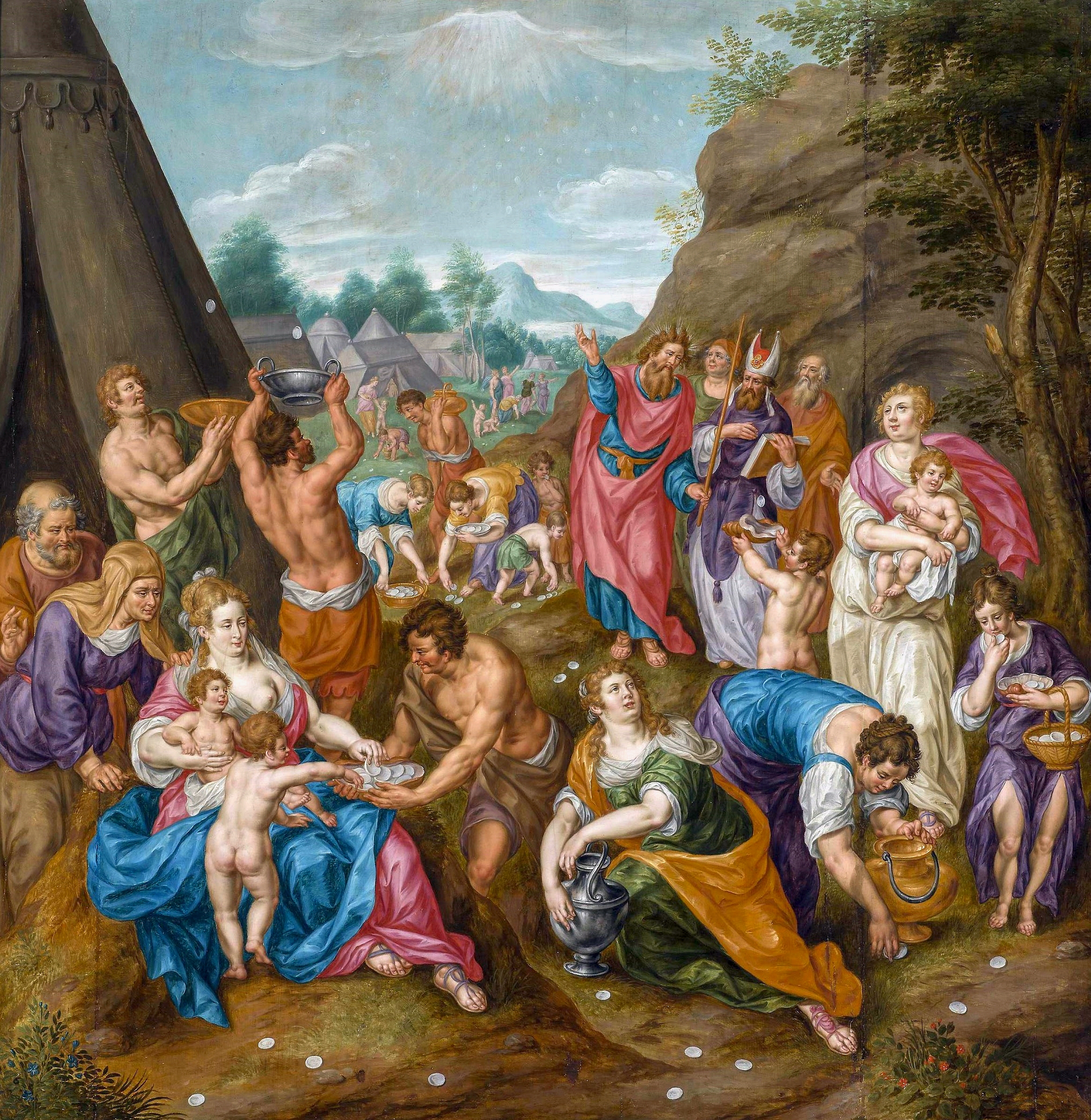
He spoke about the Israelite’s experience in the wilderness. Each day, they were given exactly what they needed to be sustained for that day. No more. No less.

We need to remember, like the Israelites, how incredibly miraculous that still is. We need to remember, like the Israelites, how sweet our daily manna can be to our souls when we stop complaining that it’s not the miracle we’d hoped for. We need to remember, like the Israelites, that our lack of over-abundance doesn’t negate the fact that we are given all that we need to thrive.


Israelites Gathering Manna by, Hendrik de Clerck

It is my experience that when we are obedient to the laws of the Gospel of Jesus Christ, we will be sustained by heaven-sent nourishment. We may not know everything, but we can know enough. When we are hungry, we will be given manna sufficient for the day. When we thirst, the Savior will give us His living water. This is the kind of nourishment that sustains us as we digest our darkest days and helps us be filled with joy.

In D&C 11:13 it teaches, “Verily, verily, I say unto you, I will impart unto you of my Spirit, which shall enlighten your mind, which shall fill your soul with joy.”

What a shame it would be if we starved ourselves of those blessings just because we’re waiting for an instantaneous feast that the Holy Ghost gives us bit by bit, day by day, according to our faithfulness.

So, when questions loom large, and the Spirit’s whisperings seem incomprehensible, how do we recognize the nourishment we’re given? Elder Bednar taught, “We have to act, then we find out if it’s coming from [us], or if it’s the power of God. Everything that invites and entices to do good, and to be good, comes from God.”

In anticipation of the question of why our Father in Heaven allows the Holy Ghost to work in this manner, he continues, “Why not make it easy to recognize all the time? I would suggest that the simple answer is because God trusts us. He shouldn’t have to dramatically shake us to get our attention.”

In other words, our loving Heavenly Father believes in our ability to act. As His children, He wants us to become even as He is, and thus we must learn how to be actors, producers, and authors in our own lives.

“For God hath not given us the spirit of fear; but of power, and of love, and of a sound mind.” Surely, this is manna from heaven.

Preach My Gospel expounds upon this principle when it says, “God loves you and all His children. He is anxious to support you in your practical and specific challenges. You have been promised inspiration to know what to do and have been given power to do it.”

When we face decisions that feel hazy, we need to remember that the Spirit will guide us. We may be allowed to follow the wrong path for a time, but when we are sensitive to the Holy Ghost, we can rest assured that we will not be penalized for our righteous desires.

The Spirit’s voice may be still, and it may be small, but it is powerful nonetheless. Its witness can change our hearts and minds. Its comfort can heal our hearts and minds and its warnings can protect them.

To that end, we must remember to make the time and effort to sanctify ourselves and make room for its influence in our lives. This world is filled with literal and figurative noise that can drown out the soft promptings of the Holy Ghost.

Our Father in Heaven needs you and your unique contributions. You are powerful and singly equipped to help in the cause of our Savior. Be ready to answer the call by being prepared to feel the Spirit and committed to doing as it instructs.

It is my testimony that when we do as the Holy Ghost asks, we become mighty tools in His hands. Playing a role in His work brings a peace and a grounded joy that can be felt in no other way.

I’m eternally grateful for the manna that I’m given. I know, from experience, that the Holy Ghost will provide sufficiently for each day. When I have the faith to remember that, everything changes.

It is my hope and my prayer that you will partake of the promptings of the Holy Ghost in abundance, always remembering that we have a loving Heavenly Father who is acutely aware of our needs. As you are on His errand, He will feed you. Please, have faith in that.

memes-gordon-hinckley-quotes-1928655-print-1
Latter-day Counsel: Excerpts from Addresses of President Gordon B. Hinckley

The Privilege of Suffering With You

Anyone who knows me knows that I love learning about all things empathy. My inner hippy believes that unalloyed empathy, when paired with precise and thoughtful communication, can truly change the world. This belief drives much of what I do, including the kinds of nerdy rabbit holes I unapologetically jump down. During one such indulgence, I stumbled upon a fascinating study conducted by Dr. Lasana Harris and Dr. Susan T Fiske (professor of Amy Cuddy, for you TED buffs out there) titled, From Dehumanization and Objectification, to Dehumanization: Neuroimaging Studies on the Building Blocks of Empathy.

In it, they scanned the way the brain’s Medial Prefontal Cortex responded when shown pictures of different groups of people. Psychology Today described its function by explaining, “Basically, this area of the brain…activates when people do things that involve perceiving and relating to other people, such as recognizing and distinguishing between faces and empathizing.”

Their findings revealed that in every situation they presented, the brain’s mPFC was activated, except one. When participants were shown images of homeless people, their scans revealed that they activated the part of the brain that identifies tools and other objects (my understanding is that further studies showed that the only other instances they’ve seen this phenomenon is with drug addicts and when pornography consumers view pornographic images—a discussion for another day). In other words, the mind dehumanizes these individuals and views them as objects instead.

The researchers hypothesized that this was because an individual’s attitude toward another person is largely based upon their perception of that person’s competence and warmth. While I believe this may be a factor, I think there’s something else at play.

That is, the human mind does everything it can to avoid pain and discomfort. By viewing homeless people as equal to them, the empathetic response would be emotionally taxing and even painful. If, on the other hand, we view them as objects, we can avoid the discomfort and dissonance associated with such stark disparity and suffering. Simply put, it’s a defense mechanism.

As a result of this assessment, I determined that I would do everything in my power to lean into that discomfort. I wanted to hurt for people that were hurting. I wanted desperately to rewire my brain and see people for the incredible children of God that they are.

While I can confidently say that I have a long way to go, I have come to recognize something. It is a sacred privilege to suffer with another human being. We all know that hardships are a mortal inevitability, but we rarely allow others into our sacred stadiums of suffering. The amphitheaters wherein we face our greatest challenges and conquer our darkest demons.

I love being invited there. I’m not saying we should share these spaces with just anyone. What I am saying is that there’s something beautiful in letting others in. In our moments of weakness, the ones we’ve granted entrance to can help buoy us up. Many people believe that suffering alone, and in silence, is sign of strength. Perhaps we don’t even consciously make those assumptions, but it is an easy default mode.

After all, it’s terrifying to let people watch us fail. And in the stadium of suffering, we are bound to fail at some point. But this life isn’t meant for us to win in the way the world would have us believe we must win. There is beauty in the struggle. The Savior is in the struggle. He’s the only one that can help us win for good because He’s the only one that has won for good. Don’t let Him, or those who care for and root for you, wait outside while you face the toughest exhibitions life can throw your way.

And as a person who has had the privilege of being in the arena with those I know personally and those known by the Heavenly Parents we share, I can say it’s an exceptional blessing to, “mourn with those that mourn… and comfort those who stand in need of comfort.”

Elder Ronald A. Rasband taught, “Often we are given the opportunity to help others in their time of need. As members of the Church (and might I add, all people who seek to honor their God and their fellow man), we each have the sacred responsibility “to bear one another’s burdens, that they may be light,” and to “lift up the hands which hang down, and strengthen the feeble knees.”

Many people say that being invited into other’s arenas makes our own seem less daunting, and perhaps that’s true. That’s not the point of my message today. I believe wholeheartedly in embracing our circumstances and all the emotions that go with it. In my life, that’s been essential to healing.

But I do think that there’s something profoundly powerful about suffering with others. It helps us learn how to love and feel loved. It helps us come to know God and see God in the world around us. It teaches us how to fight our battles with grace and see the strength of the human spirit. It helps us feel joy more purely.

While it’s entirely natural to avoid pain, I echo the sentiment of President Thomas S. Monson, when he taught, “We are surrounded by those in need of our attention, our encouragement, our support, our comfort, our kindness—be they family members, friends, acquaintances, or strangers. We are the Lord’s hands here upon the earth, with the mandate to serve and to lift His children. He is dependent upon each of us. …”

Our minds may indeed be wired to avoid staring face to face with the suffering of others, but that makes the privilege of suffering with them that much more special. To those who have trusted me enough to let me in, thank you.

To those who understandably turn their faces from pain, I dare you to turn back. I dare you to be there. I dare you to feel the privilege of suffering.

To those who are in the midst of their fight, keep on fighting. Remember that there is always one who is in the stadium of suffering, ready to help us conquer any fight we will ever face. Remember to take hope. Remember that the battle has been won.

If You’re a Bird, I’m a Bird. If I’m a Lily, You’re a Lily.

Hello, old friends, it’s been well over a year since I last wrote on this blog for personal reasons, and even longer still since the last time I wrote for it natively. I’ve been extraordinarily busy (more on that in a moment), but I also have to admit that I’ve been suffering from a severe bout of writer’s block. I don’t like that. I’ve been surrounding myself with inspiration, and I think I’ve finally found my voice again.

But, before I begin, I need to tell you a bit about what my life has looked like for the last year:

I’ve been working nonstop to complete my undergraduate degree and finally reached the finish line. I am a gushing alumnus of BYU-Idaho—seriously though, I love my school. I started working for a local nonprofit that serves victims of domestic violence and sexual assault and fell absolutely in love with my job. I started an organization called Closed to Close; we work to help people build bridges instead of walls. I decided that, in order to be a better advocate for the causes I’m passionate about (namely religious freedom), I should consider going to law school. I took the LSAT (ew.). I introduced myself to the completely foreign world of law school admissions and set my sights on DC and Provo (ew… kidding. Kind of). I got accepted to the two schools I was excited about. I agonized over my decision. I chose a school. I continue(d) to agonize over all the life-altering choices on my horizon. I wrote this paragraph, which is entirely too long, just to scratch the surface of the tangled web that is my life. All the while, trying to balance the responsibilities that come from being a daughter, a sister, a single person, a professional, and an active member of my church.

See, it turns out, trying to be a person of purpose and passion is absolutely exhausting. I fell in love with so many things that I completely drained my energy and here I sit, at the precipice of an undeniably defining moment in my life, feeling totally gassed. Depleted. Shattered. And honestly, a little bit paralyzed.

I hate that feeling. But it’s one that I know. I know fear. It stalks me.

It’s the guard dog in the yard of my scary neighbor, and it seems that every time I get a new dream, I fling that thing right over the fence.

It’s a mirage of thieves standing between me and a stream in the desert. It’s fake. But gosh, it feels real.

I wake up each day, and I do my best to defeat that old demon, and I’d like to think that most days I win. But when I’m tired it gets hard. And so I grasp to the knowledge that Satan has always plagued even the best of mankind with, “strong, preliminary, anticipatory opposition to many of the good things God has in store for us.”

But more than that, I grasp at the knowledge that I can’t resist that kind of opposition on my own, and thanks to a loving Savior, I don’t have to.

And while I could easily speak on the subject of fighting the good fight, and perhaps I will at some point, today I want to focus on the fact that sometimes we need to just let go—because, for me, that’s often the hardest battle to win.

I was searching the scriptures, trying desperately to find the kind of counsel that would allow me to move forward with certainty. Also known as control. My favorite frenemy. In the midst of this frenzied study, I read the Sermon on the Mount. I didn’t necessarily love what I saw, but I knew it wasn’t an accident that those words were the ones in front of me.

I’ve always said that if God will tell me His will for my life, then I’ll do it at whatever cost. But that’s always necessitated absolute clarity about what that was. In the Sermon on the Mount, Jesus smashed that need for that plush, idyllic illusion.

He taught:
“Behold the fowls of the air: for they sow not, neither do they reap, nor gather into barns; yet your Heavenly Father feedeth them. Are ye not much better than they? Which of you by taking thought can add one cubit unto his stature? And why take ye thought for raiment?
Consider the lilies of the field, how they grow; they toil not, neither do they spin. And yet I say unto you, that even Solomon in all his glory was not arrayed like one of these. Wherefore, if God so clothe the grass of the field, which today is, and tomorrow is cast into the oven, shall He not much more clothe you, O ye of little faith?”
“But seek ye first the kingdom of God, and his righteousness; and all these things shall be added unto you. Take therefore no thought for the morrow: for the morrow shall take thought for the things of itself. Sufficient unto the day is the evil thereof.”

In other words, if God makes it so that a pigeon, the rat of bird species, is taken care of, what makes you think He’s not invested in your success? If flowers that are capable of no more than swaying in the breeze are made stunningly beautiful, what makes me think that He’s not perfectly aware of His daughter (or son)—the one He’s given the potential to become even as He is?

Inherent in His perfect plan is everything we need to succeed. He wants nothing less than that for us. Like the lilies of the field, if we stay grounded, He has provided every nutrient and necessity we need to allow our roots to grow deep.

It means that “when the devil shall send forth his mighty winds, yea, his shafts in the whirlwind, yea, when all his hail and his mighty storm shall beat upon you, it shall have no power over you to drag you down…”

I know that the choices I’m making constitute incredible blessings, but I also know that the charge to put our trust in our Savior is true in every situation, especially when we are in the throws of what can only be described as hell.

I’ve had the sacred privilege of watching some of God’s children walk through the darkest valleys and climb the most treacherous mountains life can form. Addiction. Sin. Sexual abuse. Sickness. Domestic violence. Death. Depression. Divorce. Each far beyond the limit of what a human being should be able to endure. And yet, I watch as those people in every situation survive in spectacular ways. Always drawing upon an unspeakable power that they didn’t know they had.

What they don’t always recognize is who they are and whose they are. If we perfectly understood that, we would never need to watch our backs for the fear that so easily overcomes us. It wouldn’t fix all of the problems in our lives, nor would it negate the very real need to reach out and get help, but it would help us realize the eternal perspective we need to endure in our hardest moments.

If we understood that we are literal sons and daughters of the Creator of the universe and that we have inherited those same attributes, would we feel paralyzed by the things that come our way?

As impossible as it may feel at times, I know from experience that when I let go and focus wholly on the relationship I have with my Savior, everything else falls into place. Without exception. Not always (not usually) in the way I anticipated. Not always (not usually) with the same time-frame I had in mind, but always better than I could’ve dreamed.

I guess what I’m trying to say is this:

I’m a bird. And sometimes I fly against the wind. And I exhaust myself in the pursuit of where I think I’m going. But the truth is, if I just let go, I’m always taken care of. Maybe one day I’ll reach the heights I’ve always dreamed of, but it’s not my job to force that into reality.

And as much as I aspire to be someone or something that changes the world, I’m also a lily. Because try as I might, most of the control I have is a perception. In actuality, I’m fed by the Son, and that is enough.

I don’t need any grand illusion of being anything else because if I’m a lily, you’re a lily. If you’re a bird, I’m a bird. We are what we need to be. Not because we’re perfect, but because He is. And that’s a beautiful thing.

So, look up. Let go. And know that everything will be okay.

Bind My Wandering Mind to Thee: When Godly People Become Victims of Lying Minds

Author’s Note: This was originally written as an oratorical, congregant-led sermon (except the last few lines which were delivered extemporaneously during my talk ). Thus, in a battle between grammatical accuracy and auditory appeal, the sound rules the day. Be patient with me and please, enjoy the lesson and leave your input below!


Good afternoon brothers and sisters. My name is Tiffany Osborn, and I’m grateful for the opportunity I have to speak to you. My thoughts today differ somewhat from many of the lessons we typically hear.

We frequently hear about the common cycle of temptation, hard-heartedness, sin, repentance, gratitude and the resulting peace and happiness we feel as we become perfected through the Atonement of Jesus Christ.

Today, however, I wish to speak candidly about what happens when, through no fault of our own, we find ourselves devoid of the peace and happiness that normally accompany the pursuit of living a righteous life.

It’s important that we distinguish the difference between the unsettled, unhappy nature of sin and the legitimate trial of mental and emotional sickness.

There is a dangerous misconception that if we are unhappy it is always because we are sinning. Certainly it’s important to take a brutally honest inventory of where we are in relation to where we ought to be, and how we can more fully live after the manner of happiness but I want to be clear about what we should do in cases where we’ve done nothing wrong and we still experience a heavy heart.

Today, I want to look at the heart and the mind and what happens when they don’t work synergistically with one another. It is my prayer that my message today can be a conduit through which the Spirit can clearly communicate with you truths about how to live with and love those who struggle.

Elder Holland explained that the heart is: “…the figurative center of our faith, the poetic location of our loyalties and our values.” In other words, the heart is the center of who we truly are.

So, when people are depressed, anxious, or suicidal, does that mean that their heavy heart is a result of some self-inflicted heart disease? Absolutely not! It’s much more likely that they are the victims of a convincing and lying mind. One that tells them that their struggles make them flawed or broken. A mind that tells them that their heart is far removed from the divinity that is inherently theirs.

What complicates things more is that when people are victims of this oppressive state of mind for too long, it can cause the heart to figuratively break, further confusing the real state of a person’s value.

So, the question becomes: how does someone untangle the lies and sift through the darkness, fear, and hopelessness to ultimately find happiness or at the very least, some sense of peace? I don’t pretend to have all the answers to this complex question, but I can share some of the wisdom I’ve garnered along the way.

This limited wisdom is the result of years of personal experience, the experiences of loved ones, research, counseling (both giving and receiving) and the byproduct of speaking on the issue to over a thousand people in a non-religious platform.

The way to traverse mental illness is through multiple avenues. Because we are eternal beings, it is important that we address both the spiritual and medicinal avenues that should work in conjunction with one another to find the most healing we can.

While I can’t speak with much authority about the medicinal avenue, I can advocate strongly for it. Our merciful Heavenly Father has blessed mankind with tools that enable His children to limit their suffering; we should learn how to drop the stigma and embrace that blessing. Proper medical attention can be a game changer. Please take full advantage of these options as you determine fit.

My purpose today, is to primarily address the spiritual avenue. I hope you’ll stick with me then as I metaphorically blur the line for a moment.

I love studying the human mind and what an incredibly powerful machine it is. I work in advocacy and every day I get to witness the profound resiliency a person has, even power they didn’t know they had. But, the mind is also fallible.

The same mechanisms that create neurological pathways in our brains that allow us to survive in spiritual and physical crisis are the same synapses that can misfire when mental health disorders teach our minds to go rogue.

Our mind has a memory. And when it remembers how to feel depressed, anxious and hopeless, it can become easy to find ourselves in the same rut over and over again. What I have learned though, is that the heart also has a memory.

Our hearts, at the most fundamental level, remember that we’re children of God. It remembers that there’s a Savior who lived and died for us. That we have the tools to leave hopelessness by the wayside as we embrace our eternal destinies. That all pain and sorrow will be washed away. That unfathomable happiness awaits us. That better is coming and all of God’s promises will be fulfilled.

But that knowledge is locked away in the deepest, most sacred recesses of our hearts. If we allow our hearts to become hardened we lock up that beautiful message. When our minds are feeble, it is imperative that our hearts are pure.

If our hearts are pure, we allow the great artist to fix all that has been broken. One poet described what can be done when we fall or break:

“He gently swept up every piece
And begins to show His expertise
Making a new masterful design
Heats the fire and starts to refine
Pouring into a new complex mold
A new story that’d never been told
Soon the work is close to done
The fall is all but overcome”

You see, individuals who suffer from mental health disorders and the people who care enough to ‘mourn with those that mourn; yea, and comfort those that stand in need of comfort’, can be enabled to transform their broken shards of glass to become stunning new masterpieces. And when the world looks through those windows, they can see the world in a new way. There is strength that can be found in suffering, if we make it so.

Arthur R Basset explained in an Ensign article, “Perhaps what the world needs most during the trials of life is fewer “Job’s comforters,” with their patented rational explanations, and more men and women with the Job-like faith that can still cry out from the depths of anguish, “Though he slay me, yet will I trust in him. …””

Even still, enduring our trials, especially those as pervasive and consuming as depression and anxiety can be a monumental task.

Scriptures that say things like, “My son, peace be unto thy soul; thine adversity and thine afflictions shall be but a small moment; and then, if thou endure it well, God shall exalt thee on high; thou shalt triumph over all thy foes,” can come as little consolation in the depths of our trials. But again, this is when it is so vital that our hearts are soft and that those words can strike a chord in our eternal center, to remind us that all of God’s promises will be fulfilled.

When life presents us with sorrow, it would be well for us to use the last drops of our energy to lift our heads and look meekly heavenward.

Jesus Christ truly did suffer for all of our afflictions. We are never truly alone when we remember that He knows exactly what we have felt.

As Jeffrey R Holland Taught, “Hope is never lost. If those miracles do not come soon or fully or seemingly at all, remember the Savior’s own anguished example: if the bitter cup does not pass, drink it and be strong, trusting in happier days ahead.”

Brothers and sisters, no matter how bleak your world may become, I have a sure knowledge that you are strong enough to bear those burdens through the Atonement of Jesus Christ. I know this from personal experience. You are stronger than you know and He is closer than He seems.

In our moments of weakness it is my prayer that we will feel compelled to cry out:

“Jesus sought me when a stranger
Wondering from the fold of God
He, to rescue me from danger
Interposed His precious blood
O to grace how great a debtor daily I’m constrained to be!
Let thy goodness like a fetter, bind my wandering heart to thee
Prone to wander Lord I feel it, prone to leave the God I love
Here’s my heart, O take and seal it, seal it for thy courts above”

How wonderful it is that we have the power to bind our wandering hearts, and especially our wandering minds to He who can make us whole.

Wandering Mind-03God is aware of His children. He loves us. He will fulfill all of His promises, including the ones that promise our eternal exaltation and joy. Our Savior truly did suffer for our pains and afflictions and is waiting to succor His people. He has the power to help us overcome our adversities or become strong enough to bear them. The church of Jesus Christ has been restored to the earth. What a blessing that has been in my life, and can be in the lives of all who embrace it. That is my prayer, in the name of He who can make us whole, even Jesus Christ, Amen.


Would you like to read a related post? Check out Commandments Hold  Me Back here.


It’s Nun of Their Business: Why Religious Groups Shouldn’t Be Compelled to Enforce What They Don’t Endorse

Today is a big day. Here’s why:

A quick Google search will give you more than one story involving a religious group contesting the HHS Mandate that is part of the Affordable Healthcare Act (Obamacare). What is the HHS Mandate? Allow me to explain:

  • Part of Obamacare requires employers to provide FDA-approved contraceptives to their employees; the Department of Health and Human Services (HHS) issued a mandate that began enforcing this rule several years ago. These contraceptives include traditional forms of birth control as well as new implantation prohibitors like Plan B (the morning after pill) and Ella (a related pill that can be taken a week later).
  • They do allow a kind of ‘exemption’ wherein the government pays for the coverage so for religious organizations. The obvious concern is that for many of these organizations, their complaint is not just in paying for the coverage, but in providing it at all. It violates their religious convictions, regardless of who pays for it.
  • Not everyone is being required to follow the HHS Mandate. In fact, one-third of Americans aren’t held to the standard. For example, the US military doesn’t have to abide by the rule. Other groups include large cities and corporations who already provided healthcare for their employees (groups like Pepsi, Visa, Exxon, etc.).
  • There is also an exemption for religious employers. Edward Whelan explains the details of this exclusion and its implications for the Catholic church, but clearly, the repercussions are far broader when applied to all religious groups:

Whelan argues, “The HHS rule would allow (but not require) the HHS bureaucracy to establish exemptions from this mandate only for an extremely narrow category of “religious employers”: an organization qualifies as a “religious employer” only if its purpose is the “inculcation of religious values,” it “primarily employs persons who share the religious tenets of the organization, “and it “serves primarily persons who share the religious tenets of the organization.” As the head of Catholic Charities USA observed, “the ministry of Jesus Christ himself” would not qualify for the exemption. Nor will Catholic Charities, Catholic Relief Services, Catholic hospitals, food banks, homeless shelters, most Catholic schools, and even many or most diocesan offices, much less Catholic business owners who strive to conduct their businesses in accordance with their religious beliefs.”

Many find it unsettling to see how many religious organizations are finding themselves in situations where they have to fight to protect their beliefs against the HHS Mandate of the Affordable Healthcare Act. If the courts choose to uphold this mandate, they will be endangering the constitutionally-protected right to live according to one’s sincerely held religious conscience. But some believe it doesn’t have to be this way.

Perhaps the most notable of these cases is Little Sisters of the Poor v. Burwell. The case is set to appear before the Supreme Court for oral arguments on March 23rd. The passing of Justice Antonin Scalia is a significant concern for some because he was widely known as the justice known for championing religious liberties.

While I’m not part of the Becket Fund for Religious Liberty’s counsel (the group representing the Little Sisters of the Poor), I can make a fairly confident conjecture as to the relevant arguments they may make. These arguments apply to all such cases and should provide a foundation, however small, to begin to understand why many people of faith believe it’s so important that the HHS mandate is overturned in favor of a standard that can be met fairly and equitably to all parties affected.

The first and most prominent would be that the law fails to reach RFRA (the Religious Freedom Restoration Act) criterion. The federal law (and its companion state laws) is meant to protect religious people everywhere from government encroachment and coercion, thus maintaining government neutrality in matters of faith. The law uses the Sherbert test to determine whether or not First Amendment rights have been violated; Assuming that the objection to the law is derived from a sincerely held belief the questions become:

  1. Has the law “placed a substantial burden on the observation of a central religious belief or practice”?

About the Little Sisters of the Poor case, Becket would argue that the obvious answer is, “yes.” The government’s mandate imposes a practice that violates their core belief system and puts undue pressure on them to turn their back on the free exercise of their religion by issuing exorbitant fines and possibly taking away other services normally provided by the government.

  1. Does the government have a compelling interest to do so?

Some are not convinced that there is a compelling government interest to provide contraceptive care to its citizens. They may argue that while most can make a compelling case—regardless of political opposition—that providing healthcare to the public is an important issue, but question if contraceptive care serves government interests? Birth control is important for many individuals, and the vast majority of people think women should have the right to access that care if they so desire, but there is a question about if the government has a stake in the matter.

  1. Is the law being enforced in such a way as to limit the restriction placed upon the individual? Or, in other words, is there a less restrictive way to achieve the same end [assuming that there is a compelling interest]?

Becket will argue that there are other ways in which the government could impose the same mandate in a way that would limit the imposition on the right to free practice of religion. The option that the Becket Fund has put forth was explained this way:

“There is an easy solution that protects the Little Sisters’ religious freedom and the right of the government to offer these services to women who want them. Rather than trying to force religious plans to offer these services, the better solution is for the government to provide these services through the ACA healthcare exchange to any employees who want them but can’t get them through employer plans.

The Little Sisters are not trying to prevent the government from providing these services but object to the government’s insisting the Little Sisters provide them (especially since the government has already refused to ensure that those free services are provided to one in three Americans). Giving all women access to contraception through the healthcare exchange is a simpler and fairer way for the government to provide these services to more women while protecting the religious freedom of the Little Sisters, who never wanted this fight and just want to get back to caring for the elderly in need.”

No alt text provided for this image

Many concerned people of faith are concerned about the implications of this ruling. This community believes that the court ought to give preference to the Little Sisters of the Poor because if not, they fall victim to compelled speech. Put another way, they will be forced to represent a narrative that they do not endorse.

There’s plenty legal precedent involving compelled speech, and the highest court in the land has made it clear that compelling speech is in violation of the first amendment and is, therefore, unacceptable by that standard. Indeed, the standard by which all laws must be held accountable makes it clear that this is simply unacceptable.

One such example is Hurley v. Irish-American Gay Group of Boston (1995). In that case, the court established that, “”Since all speech inherently involves choices of what to say and what to leave unsaid,” Pacific Gas & Electric Co. v. Public Utilities Comm’n of Cal., 475 U.S. 1, 11 (1986) (plurality opinion) (emphasis in original), one important manifestation of the principle of free speech is that one who chooses to speak may also decide “what not to say.””

If the court agrees with those who believe the mandate equates to compelled speech, the law would therefore be unconstitutional and an alternative option must be given in order to reach a harmonious balance of the government’s interests and the vital rights to practice free speech and religion.

This issue is important for people across the religious spectrum, and indeed, to people everywhere, because rigorous debate and thoughtful consideration must always employed at the highest level when considering rules that may implicate the free practice of one’s faith. Perhaps this particular case only impacts the lives of several nuns and the benefactors of their service (which, shouldn’t be minimized), but the implications impact everyone.

It means that the government can exist in harmony, without possibly forcing the moral motivations of others to be left by the wayside. This issue is one of balance, which has always been at stake and must always be at the forefront of these issues.

For some people of faith, the message is clear: in relation to the contraceptive mandate, it’s nun of the government’s business (pun intended). While questions about how to strike the proper balance will continue to be one of great concern and debate (and rightly so), the message is clear: The right to the free exercise of religion is one that must be protected.

Why Religious Liberty?

I’ve always loved the idea of protecting religious freedom, but it wasn’t until recently that I chose to decisively move forward with a career in this field. But why, when I’m interested in a wide variety of things, do I feel that this is what I need to commit my life’s work to?

As a young child I was fearless. I was willing to speak about my faith with anyone. I was an old soul who loved contemplating existential questions and the purpose for which I was created. I frequently sermonized strangers that were ten times my age. I paid no regard to the separation of church and state or any social norm. All I knew was that I loved my God and I wanted to shout that from the rooftops.

I remember going to read Holocaust books with my Jewish principle and having long conversations about religious persecution and ideology. Mormons and Jews know a bit about being hated for their religious convictions, so we bonded over that. I loved speaking about my faith and hearing about other’s.

Toward the latter end of my elementary school experience I had a teacher who changed everything. Up to that point, I loved everything about school. I was the shameless nerd who brown-nosed my teachers a lot; not because I wanted to gain any favor over other students, but because I was bold enough to view them as my intellectual peers… I never said I was normal.

Suddenly however, I remember feeling blatant hostility from a new teacher. I was confused but continued to lead a publicly faith filled life. Soon, I was being kicked out of class daily. I wasn’t acting out, I just wasn’t wanted. My opinions were ‘distracting’. When I started to fall behind I was accused of being lazy, and when I reached out to others, I was called a liar. I quickly lost my zeal for school and fell to the background. I felt shamed and worthless all because a teacher decided that sharing about something I loved made me worthy of being hated.

From that point on, I was hesitant to share much about my faith. I still would, but with the constant fear that I would receive ridicule or backlash for expressing my beliefs. I resorted to having conversations about things that were ‘safer’. Things like sports, boys, etc. Years passed and I’d become accustomed to the safe and timid of the sacred.

Criticism

Luckily, God pushed me out of my comfort zone and back to a place that mattered more to me. During my sophomore year of high school I became too sick to continue living the active lifestyle that allowed me to avoid my inquisitive mind and passion for gushing about my faith. I craved being part of a team again and so I resorted to speech and debate. For a while it was my dirty secret but now, I view it as the propulsion that got me back to who I truly am. I’m so grateful for that.

Today, I find myself committed. Committed to being one of the guardians of religious freedom. Now, perhaps that seems a bit ambitious. Understand me when I say that it is. I don’t expect to change the world, but I do expect to be one of the forces constantly applying the pressure necessary to move forward. I never want my children to be fearful of the backlash they’d receive for openly living according to the tenants of their faith. I want to help create and maintain government atmospheres that recognize the invaluable import of religion in society.

People seem to have forgotten that regardless of their personal convictions, religious freedom is vitally important to any culture. I plan on expanding on all of this in the near future, but for now, suffice it to say that I am ready to dive in. I have more than a little to learn. But that’s the beautiful thing about passion: it makes that unknown thrilling. So, let’s get to work.

We Are All Wounded

This week has been interesting. After a long (though welcomed and needed in many ways) Christmas break, I was looking forward to getting back into a schedule. Over the years, I’ve become rather fond of having somewhere to be. While responsibility can mean exhaustion, it can also mean fulfillment and progress. That’s what I was looking forward to.

Even after an exhausting, difficult day at work this week, I felt so blessed to be busy again!

Though, I have to admit, I didn’t get off to a great start. After a long series of events, my Sabbath day became less lovely than it usually is—we’ll leave it at that. I had made a commitment however, to pick up a friend from a bus stop and drop her off at her apartment. I grudgingly trudged out of my home at 10:40 PM to do what I wished I hadn’t promised to do. But fulfilling that promise ended up setting the tone for a gratifying and moving week.

There was a devotional on the radio that reminded me why I’m here and what I hope to do during the coming semester. The speaker, Greg Klingler (Faculty Member at BYU-Idaho), taught about understanding who we are, and not discrediting ourselves because of who we are not. He compared us to the body of Christ. Referring to Corinthians chapter 12 he read:

“For by one Spirit are we all baptized into one body, whether we be Jews or Gentiles, whether we be bond or free; For the body is not one member, but many. If the foot shall say, Because I am not the hand, I am not of the body; is it therefore not of the body? And if the ear shall say, Because I am not the eye, I am not of the body; is it therefore not of the body? And if they were all one member, where were the body? But now are they many members, but one body.”

Explaining further Klingler remarked, “When we are baptized we become a member of the body of Christ. Each member of the body is given important gifts, and talents. Some taste, some hear. Some are eyes, and some are hands. God set the members, “every one of them in the body, as it hath pleased him.””

christus-foot-lds-454937-mobile

“When one part of the body is afflicted, the whole body feels it, and we are not whole until all members of the body are whole… When one of us suffer, we all suffer.”

Do we suffer when our friends and family suffer? Perhaps, but what about that person you struggle to understand? How often do we allow others to walk a lonely road of pain and affliction without coming to their aid? In addition, how often do we discredit our own worth because we don’t play the same role as the person next to us?

If we could come to have a healthy understanding of the role we play, and the importance of the other players, no matter their function, the world would change. We would become more vigilant to the needs of those with whom we associate. We would become more forgiving. We would be able to work in ways that we cannot do alone.

And yet, we often feel isolated. One of the most dangerous trends I see in my community, and throughout the world, is a sense of judgment when we see the sickness in others. Do we not recognize that we are all sick? That we all desperately need the help of the Physician?

In some ways we may desire to be seen as perfect and unflawed, but I believe that at a deeper level, we want to be seen where we are. We so badly wish that others would look to us, and see our bruises and come to our aid but we look at our fellow man with far less mercy than we want for ourselves.

Perhaps this is because we see a better way and wish that they would avoid unnecessary pains, but once the damage is done, there’s no use in focusing on why they were injured. That time has past. The time for love, compassion and aid has arrived.

Unfortunately, I have seen many people put off the healing power of the Atonement because they are afraid of the retaliation of the people with whom they associate. What difference would it make if we stopped looking at those who have to skip the sacrament as broken goods and started seeing them for what they are– healing children of God?

The speaker showed the proper way to treat the injured we may encounter along the way: “To those able and willing to go to the rescue, this will be our message, ‘We love you, the Lord loves you, and we need you.’”

The repentance process can be grueling, and while the opinions of others shouldn’t have a bearing on our self worth and motivations, the truth remains. If we fail to recognize the divine worth of one who is working to repent, the fault in that judgment lies not with the one who’s seeking out help, but with the one who acts like they are whole and passes judgment on the one who is meek enough to honestly seek forgiveness. We are all broken. And maybe I’m crazy, but I think that’s a beautiful thing.

Brother Klingler went on to tell a compelling narrative of wounded soldiers on a battlefield. He spoke about courageous love that allowed them to care for their wounded brethren. They didn’t critique how they could’ve avoided their injuries, nor did they hesitate to run to the aid of others because they themselves were hurt. They recognized their collective need and they moved forward with power endowed upon them from a loving God.

He continued, “As we go to the rescue, there may be times in which understanding the source of the spiritual wounds of those we serve is instructive and helpful to prevent further mistakes, but please be careful that you do not add to the pain of the wounded by casting an unrighteous judgment.”

“Imagine with me the Stripling Warriors searching diligently for their battle-wounded brothers. When finding a battle-torn brother, I doubt they provided a careful analysis of battle maneuvers or critical hindsight. Rather, I imagine one brother would wash the wounds of the fallen with his own tears while another warrior would stop the bleeding of the wounded with his own hands. Our wounded brothers and sisters need less criticism, and more care.”

This beautiful image is entitled, ‘It’s True Sir-All Present and Accounted For’ and is done by Clark Kelly Price. It depicts the famous two thousand stripling warriors after their miraculous victory where none were slain.

We may not be the Physician, but we can train to be incredibly successful Physicians Assistants. But that means we have to be present. We cannot hide out hoping to avoid the battle and come out only for the celebratory party afterwards. That means we have to be out in it. We need to be in the trenches. Running to the wounded. Digging deep and finding faith and strength we didn’t know we had.

“None of us are whole. Each of us carries wounds that can be painful and heartbreaking. At some point in our life pain, suffering, trial, and despair will bring each of us to our knees. Some of our wounds are a consequence of our own sin while other times our wounds are a consequence of the sin of someone else. Some wounds are inflicted as a result of physical or mental illness. Other wounds present in the form of a loss of loved ones, marital problems, wayward children, occupational or financial burdens, and even academic stress and pressure. The list, and possibilities of trial and tribulation is endless. However, please understand, you are not alone. Christ did not merely watch the sinners from a distance. He lived his life among them. He walked among them. He went into their homes. He fed them, He healed them, He loved them. The sinners, the homeless, the lame, the lost; He loved each one.”

“And so it is in our day. Christ does not work from the periphery. He is not merely a spectator of your life, waiting and watching to see ‘how things work out.’ Christ knows you. He is not far from you. He can heal you.”

The lessons that resonated with me are rather simple:

  1. Find my place and recognize the good that I can do in whatever role I’m asked to play. Don’t discredit myself based on the strengths of others but find my strength in the Lord. Magnify my call. Remember that magnifying my call doesn’t mean burning holes in those around me but adding to the good in the world. My light comes from Jesus Christ, and if I use it correctly, I can light a fire that warms, refines, guides, and beautifies the world.
  1. We are all on the battlefield of life. We face a real and persistent enemy, but when we work together we can be assured in knowing that we will win. We won’t come out unscathed, nor should we—especially when we’re doing what we should be doing! Let’s get scrappy. Let’s work together. Let’s run to the aid of our wounded brethren. Terrible things happen all around us everyday. Let us bring light to the darkness.

“…In this battle, one way in which we heal our own wounds is by seeking out and going to the rescue of others that are wounded. One measure of our success in this Great War with the adversary may not be how effectively I mend my own wounds, but rather how I assisted others to the source that could mend their wounds. There are many around us wounded on the battlefield. They are part of the same body of Christ that we belong to, and we are not whole until they are whole. We must go to our wounded.”

It is my prayer that as I move forward, fighting this fight, I will find those wounded. I pray that I’ll never turn a blind eye on the suffering of others. I pray that I’ll be able to come to their aid. That I’ll be ready to love them and assist my Savior in healing them. I pray that I’ll be strong enough to stand, even though I am wounded.

As the hymn says, we are all enlisted until the conflict is o’er. We are all wounded and yet we are able. And because of that, we truly have cause to ‘joyfully march to our home’.

Silence Speaks

Screen Shot 2015-12-10 at 9.54.48 PMToday I wanted to write about an infection that is crippling our society. The world breeds it and it’s more dangerous than perhaps any virus. It cripples the mind’s ability to reason; it robs countless individuals from the hope of a brighter future and it makes the pain of the present unbearable at times. But here’s the thing: it isn’t grown in a lab and nature certainly hasn’t created it. There isn’t a vaccine to cure it, but there is something we can do to safeguard our families and ourselves. I would call it a silent killer, but it’s the exact opposite. The plague I’m referring to is noise. But there’s a cure. It’s free. It’s available to anyone, and yet the treatment may seem like a tough pill to swallow.

So, let’s talk about silence. Yes, you read that correctly. I’m about to do one of the most enigmatic things possible. As a communications specialist, I am going to talk about not speaking. Or more specifically, to say something about what silence says. What you can hear in silence. What it does to our relationships with others and ourselves and the implications of noise.

I’m not speaking of the kind of apathetic silence that allows the world’s evils to be perpetrated and perpetuated unchecked and creates resentment and unhealthy relationships. No, I’m speaking of the kind of silence that speaks for itself. The silence that makes your words more meaningful. The kind of silence that can change the world.

But first, let’s talk about the world in which we now live. We currently live in a world where silence is feared and avoided. Noise pollution is everywhere and people feel uncomfortable in moments of quiet. Why are we afraid of silence, when in reality, our bodies, at the deepest biological level, are terrified of noise?

According to Greg Johnson from the University of Pennsylvania our ears do not sleep. They are like watchmen, “they are on high alert, 24/7, eavesdropping on surroundings, searching for any sound signaling danger. One of their tormentors is noise, which can panic the body like stress.”

That means that even while we are sleeping, the brain can be releasing stress hormones that will leave us exhausted and our bodies confused. According to Dr. Mathias Basner, “Noise has been associated with sleep disturbance, cognitive impairment in children, hypertension, and cardiovascular disease.” And that doesn’t even include the sociological and psychological impacts.

The incredible thing is that the louder our environments usually are, the more healing silence can be. In fact, in a study measuring the power of music, they were shocked to find that the most significant physiological result came in the brief silence between songs. The more intense the noise, the more powerful the quiet became.

But if cardiovascular disease and the like aren’t compelling enough to take silence seriously, let’s look at relationships. That includes the relationship we have with ourselves and with others.

When I was a teenager going through my obligatory existential crisis I did everything I could to avoid being alone with only my thoughts. When I wasn’t in anyone else’s company, I turned the music up to drown out the sound my own conscience and I chalked it up to the power of music; when in reality I just didn’t want to hear myself think. I was rather content with living in autopilot.

Because every existential crisis needs good friends and a bit of face paint.

You see, the silence held me accountable to the person I’d caged up inside. The better version of me who could never have been complicit in the kind of selfish, indulgent lifestyle I’d been living. The incredible thing is that at the most fundamental level, I knew exactly who I wanted to be. The problem was, it was hard and so my subconscious mind protected me from it.

I wasn’t ready to be who I knew I wanted to be. It took silence to teach me all the truths I wouldn’t admit. Silence thought me about selflessness; it taught me about faith; it taught me about fear and about failure.

Some people call personal thought meditation. Others call it prayer. No matter what you call it, science proves that the more self aware you are, the better able you are to deal with the challenges you face in life. You’ll be happier, more productive, more creative, and the list goes on. So why do we fear silence? Verbal intonation and the words we speak make up less than half of our communication and yet we focus the most on it.

The truth is, words are cheap. The kind of deep thought and empathy that is fostered in silence is the kind you have to pay a price for. It’s not for the person who clings desperately to their walls or to their masks of of disingenuous fallacious fronts that we’re so inclined to hold onto. No, silence is for the brave.

Words mean almost nothing. It’s the silence that often gives them their power. It’s the juxtaposition of silence in oppression that gives a revolution its spark. It’s that moment of silence at the end of an inspiring speech or song that resonates somewhere deep within us. The silence that comes with awe. Not because it’s compulsory but because the weight of life demands it. Because humanity can transcend language and say something more important by saying nothing.

The question is, are you wiling to hear what it has to say? You can’t hide in silence. Not from yourself. Not from others.

In fact, one of the best ways to find deeper connections in your relationships with others is to employ the power of silence. In a circumstance when conversation isn’t a necessity, sit in a room with someone you love and say nothing. In my experience it will almost certainly do one of two things.

The first is that they’ll participate in what is called companionable silence. Which to me, always turns into compassionate silence. When we don’t have noise distracting us we can sense most clearly where another person is. You will perceive their pain, their joy, their contentment. But the point is, you’ll see them where they really are. Again, you can’t hide in silence, it’s the breeding ground for vulnerability.

The second possibility is that they will open up. They’ll let you see more of themselves. When we sit in silence, we show we’re there for someone, no matter the circumstance.

I genuinely believe that seeing others this fully will foster an amount of empathy that can truly change the world. Why is it that in the moments that matter most we hardly ever remember the words we heard but rather the way we felt? Why is it that in institutions of higher learning that show us how to elevate thought, in museums that teach us to see history for what it was, in galleries where we see an artists soul, and in churches where we see the hand of God, it is always quiet?

Where noise is, chaos abides. Where silence is, empathy flourishes.

Let me be clear, I love communication in all its forms. But I think we neglect one of the most powerful tools in communications. Some of my favorite heroes throughout history were fiercely introverted. That meant that if they were saying something, what they had to say mattered. If we say something only when it matters, our words will be more powerful.

In every aspect of our life, the power of silence can elevate us above the noise that numbs. We can experience silence in the loudest rooms because more than anything, it’s a state a being. Being awake. Being teachable. Being present. Being alive and human and seeing the humanity in others.

I’ll end with the words of Macrina Wiederkehr when she said, “Silence is like a river of grace inviting us to leap unafraid into its beckoning depths. It is dark and mysterious in the waters of grace. Yet in the silent darkness we are given new eyes. In the heart of the divine we can see more clearly who we are. We are renewed and cleansed in this river of silence. There are those among you who fear the Great Silence. It is a foreign land to you. Sometimes it is good to leap into the unknown. Practice leaping.

How I’m Always Home for the Holidays

IMG_3189Throughout my life, the holiday season has always been filled with the scents of homemade treats and sentimental memories. It’s a time to cut back on everything that doesn’t matter and focus on everything that does. Faith. Family. Food. Each home has its own traditions and as children grow, they often cherish those memories of a simpler time gone by.

When my family made our sojourn from the homeland, (a sojourn that took us a whopping 600 miles. I’m being dramatic.) we eventually found ourselves seated at a very empty Thanksgiving table. Sure, we had our usual array of impossibly delicious suspects, featuring my dad’s perfectly carved turkey, but our family was missing. The sweet potatoes didn’t taste quite as sweet and the turkey not as succulent. I missed my family and friends. I never wanted another holiday season like that again.

DB43DF8D-C94C-4FEE-9D16-BE8C7FF9F902

Now I’m in school, and while I am lucky enough to be close to home and with family during the holidays, many of my friends are not. But what if I told you that you never have to be without your family during the Thanksgiving and Christmas season?

Allow me to explain. It’s about to get really Mormon, but if my friends of other faiths will be patient with me for a few paragraphs, I promise it will completely applicable to you:

This year I found myself wishing, even more than the year of the lonely holiday, that my family were closer to me. In February I had the incredible opportunity to go through the temple.

As a member of the Church of Jesus Christ of Latter-day Saints, the temple is a refuge from the storms of life; the house of God where we make sacred covenants with our Father that ensure our eternal progression. In some ways, it is the pinnacle existence in this life. It’s my favorite place.

When I was twelve, I got to go do baptisms on behalf of my deceased ancestors and this year I was able to go through and receive my endowment and make additional commitments with my Heavenly Father and learn even more about my potential.

For Mormons, each of these saving ordinances are times to celebrate. It represents so much love, and accomplishments of being clean, worthy and willing. Typically young women go through the temple for one of three reasons; the first two are seen as more common: 1. When she is preparing to serve a mission. 2. When she is preparing to be married. 3. When she has reached a point in maturity when she feels compelled to make those sacred promises and when priesthood leaders give permission. In the past this was for women who were, at the youngest, in their late twenties.

Because this is usually tied to momentous life events, LDS family members (who hold temple recommends) are frequently able go through with their loved ones. This was not the case for me. I was blessed to have all of my immediate family, who’d been through the temple at the time, in attendance. I also had several wonderful friends in the area come. However, none of my extended family was able to be there. That was hard for me. I love these humans and I wished so badly for them to experience this incredible day with me. So I invited some other family members.

The LDS church places particular attention on family history. We are encouraged to learn about our personal histories so that we can connect with them and appreciate who they were and what they did for us, as well as perform saving ordinances on their behalf. Thus, ‘the hearts of the children will turn to their fathers’.

There are incredible tools available to people who want to connect with their pasts. So, I decided to go find some family to come with me.

I researched for hours and found a large group of names. My dad and I went to the temple earlier in the week to do their baptisms (the first saving ordinance). Then, my parents went and performed additional ordinances that I was not able to do because I had not personally made those promises yet. Then the big day came. I asked each person who came with me to take one of my ancestor’s name cards. This allowed them to perform the endowment ordinance on behalf of those incredible people.

Most of my family wasn’t there. But I felt the presence of ancestors who shared my joy as we took an important step closer to our Heavenly Father, one that would enable us to live with each other for eternity. I didn’t feel alone. Far from it. While I could not see my family members there that day, I knew they were with me.

18 of us got to share that amazing experience. It was an incredible moment for my entire family. That day is one of my most cherished for a lot of reasons, but having my family there was certainly one of the highlights. It made me appreciate it in ways I otherwise wouldn’t have.

IMG_8263
That’s why, when Angie Kivett introduced me to the idea of inviting my ancestors to Thanksgiving, I knew it was an inspired plan.

She explained, “As these thoughts began to reel around my heart and mind a few months back, new impressions and priorities began to formulate. Beloved holiday traditions began to take on new meaning, excitement and purpose as family history ideas guided holiday preparations. Mixing my goals with new technological advances, I could already imagine my deceased ancestors “joining us” for Thanksgiving and Christmas this year as we share the legacy they have left for us of faith, hard work, courage, endurance and love.”

No matter where life may take us, we can always be with family. Invite your ancestors to join you this holiday season! Show slideshows of old pictures or family movies, record the memories of elderly relatives, research the lives of your ancestors, set up an online collaborative folder for family members to contribute the bits of family history they have for everyone to share, or any number of other options (Which you should definitely share in the comments below!).

This is a tradition to start as soon as you can. What a better way to appreciate the spirit of the season than by inviting and remembering those who came before. Be thankful for their legacies. Be thankful for the Savior who allows us to be resurrected and enables us to be clean and pure and live with one another eternally. We never need to be alone. I’m so grateful to know my ancestors. Their faith inspires me. Their strength beyond the veil of this life gives me something to emulate. They carry me in times of weakness. They are with me.

I love my family! We may be an odd band of misfits, but they’re my band of misfits. Our Heavenly Father is the author of a plan that enables my family from yesterday, today and forever to be together for the eternities. I love them. I’m grateful for them and I’m so excited to have them in my home this holiday season. Who will you invite this year? I’d love to hear all about it.

IMG_5459
“The divine plan of happiness enables family relationships to be perpetuated beyond the grave.”
Design a site like this with WordPress.com
Get started